
Ear Surgery in Lahore: Otoplasty & Earlobe Repair
What Is Ear Surgery?
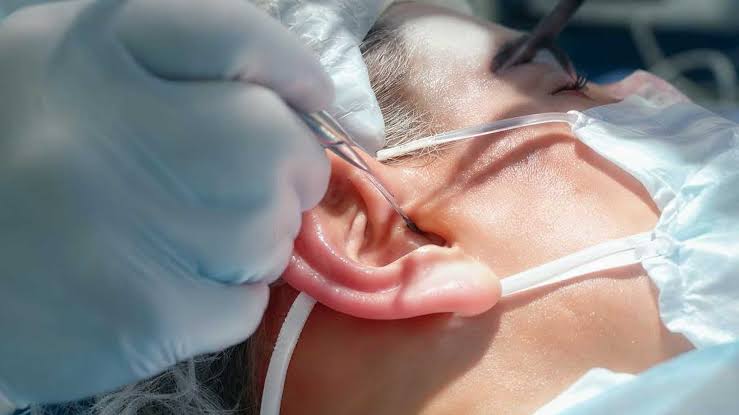
Ear surgery is a group of procedures that change the shape, size, position or condition of the outer ear. At institute cosmetique, the two most common requests are otoplasty, which reshapes or repositions the whole ear and earlobe repair, which fixes a torn, split or stretched earlobe.
Both are planned, short procedures. Both are usually done as day-care, so you go home the same day. Most people choose them for one simple reason: they are tired of thinking about their ears.
Otoplasty (Ear Pinning or Ear Reshaping)
What otoplasty can correct
Otoplasty is often called “ear pinning”, but it covers more than moving an ear backward. Depending on your anatomy, it can:
- Bring ears that stick out closer to the head
- Create a missing fold in the ear (the antihelix), which is a common reason ears stand out
- Reduce a large or overly deep ear bowl (the concha)
- Even out two ears that differ in size or position
- Reduce ears that look too large for the face
Who is a good candidate?
Otoplasty is one of the few cosmetic procedures done on both children and adults. There is no upper age limit. In children, surgeons generally wait until the ears have grown close to full size, and your doctor will tell you the right timing for your child. Adults can have it at any age, though adult cartilage is firmer and may need different handling.
You may be a good candidate if:
- Your ears stick out, look uneven or feel too large
- You are in good general health
- You want a natural, balanced result, not a dramatic change
- You are not currently dealing with an ear infection or skin problem around the ear
How the procedure is done
There is no single method that suits every ear. After examining your ears, the surgeon chooses a technique or a combination:
- Traditional otoplasty. A small cut is made in the natural crease behind the ear, so the scar stays hidden. The cartilage is reshaped and held in its new position with stitches.
- Cartilage-sparing (preservation) techniques. The cartilage is folded and secured with sutures rather than cut away. This approach aims for a softer, more natural contour and lowers the risk of an over-pinned look, sometimes called the “telephone ear” deformity.
- Incisionless (suture-only) otoplasty. Stitches are placed through tiny openings to create the fold. It suits selected patients only, and your surgeon will tell you honestly whether your ears qualify.
The operation usually takes about one and a half to two hours. It is commonly done under local anaesthesia in adults and older children. Your surgeon will advise the best option for you or your child.
Earlobe Repair
Why earlobes tear or stretch
The earlobe is soft tissue with no cartilage, so it gives way more easily than the rest of the ear. The usual causes are:
- Years of wearing heavy or dangling earrings
- An earring pulled or snagged on clothing, a scarf or a child’s hand
- Gauges or large-size piercings
- Injury or an old piercing hole that slowly widened
A tear can be partial (the hole has stretched into a slit) or complete (the lobe has split in two).
How earlobe repair works
Earlobe repair is a minor procedure done in the clinic under local anaesthesia, so you stay awake and comfortable. The steps are simple:
- The area is cleaned and numbed.
- The scarred edges of the tear are carefully freshened so they can heal together.
- The layers are stitched closed with fine sutures, usually giving a neat, natural-looking lobe.
- Very stretched or gauged lobes may need extra work, such as reshaping or reducing excess tissue. Your doctor will explain this after examining the ear.
Both ears can be treated in the same visit if needed.
Earlobe repair recovery
- Stitches are generally removed after about a week.
- Complete healing can take up to around eight weeks.
- Do not wear earrings on the repaired lobe while it heals.
- Re-piercing: wait until your doctor confirms the lobe is fully healed. For a fully split lobe, at least three months is commonly advised. The new hole is usually placed away from the scar and lighter earrings are recommended afterwards.
Otoplasty vs Earlobe Repair at a Glance
Otoplasty | Earlobe repair | |
Treats | Shape, size and position of the whole ear | Torn, split or stretched earlobe |
Typical anaesthesia | Usually local (your doctor advises) | Local |
Duration | About 1.5 to 2 hours | Short, usually under an hour |
Scar | Hidden behind the ear | Fine line on the lobe |
Recovery | Light activity in 1 to 2 weeks, full healing around 6 weeks | Stitches out around 1 week, full healing up to 8 weeks |
Possible Risks and Side Effects
Every operation carries some risk. For ear surgery, your doctor will discuss:
- Swelling, bruising and tenderness (expected and temporary)
- Infection, which is uncommon and treated with medicines
- Bleeding or a blood collection under the skin that needs attention
- Asymmetry, since ears are never perfectly identical
- Over-correction or, less often, ears moving forward again
- Visible or thickened scars in people who scar easily
- Changes in skin sensation around the ear, which usually settle
Choosing an experienced doctor and following aftercare instructions reduces most of these risks. Call the clinic promptly if you notice severe pain, spreading redness, discharge, fever or a sudden increase in swelling.
How Much Does Ear Surgery Cost in Lahore?
There is no fixed price, because the cost depends on:
- Whether you need otoplasty, earlobe repair or both
- One ear or both ears
- The technique and how complex your case is
- Type of anaesthesia and whether a day-care facility is used
- The surgeon’s experience and follow-up visits included
Earlobe repair is a smaller procedure and costs far less than otoplasty. The best way to get an exact figure is a consultation, where the doctor examines your ears and gives you a clear written estimate.
Frequently Asked Question
No. Children and adults both have it. There is no upper age limit.
In traditional otoplasty the cut is made in the crease behind the ear, so the scar is hidden. Earlobe repair leaves a fine line that fades with time.
Most people describe the discomfort as mild to moderate, mainly tightness and tenderness in the first days. Simple pain relief usually manages it.
Many adults return to light work within about a week, and children often go back to school in 7 to 10 days. Sports and heavy exercise wait longer. Your doctor will give you exact dates.
Otoplasty results are long-lasting. A small amount of movement can happen, and rarely a revision is needed. Following aftercare helps results hold.
Yes, in most cases. Wait until the lobe is fully healed, which can take a few months, and choose lighter earrings in future to avoid another tear.
In very young babies, moulding splints may work in the first weeks of life. After that, surgery is the reliable option for prominent ears. Creams, tapes and devices sold online do not change cartilage in older children or adults.
It is usually treated as cosmetic, so most plans do not cover it. Check with your insurer, especially if the problem is from an injury.