
Hairplant in Lahore: Scalp FUE and FUT, Eyebrow and Beard Transplant
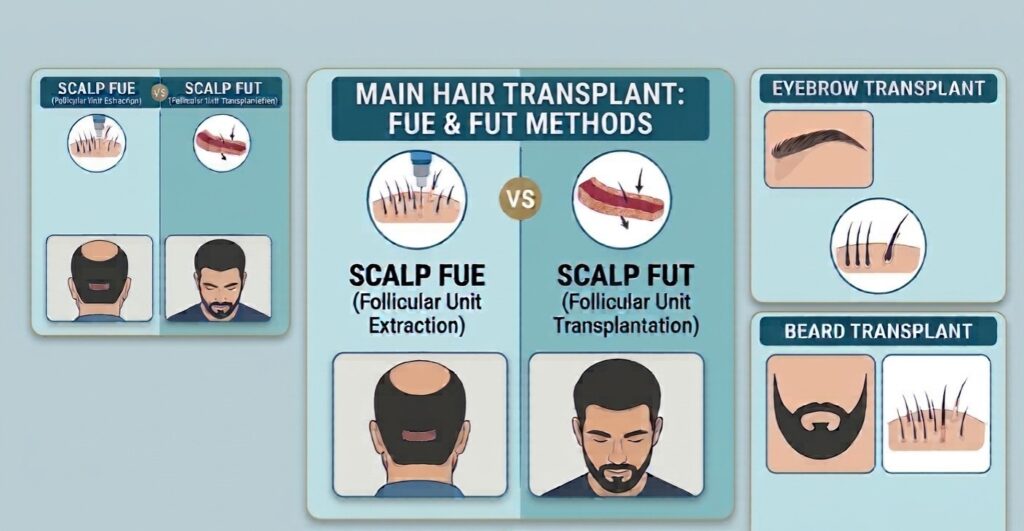
A hair transplant moves your own growing hair follicles from a safe donor zone to areas that have thinned, receded or never grown well. The result is permanent, natural-looking hair that you can cut, style and colour like the rest. This page explains the two main scalp methods (FUE and FUT), the newer techniques clinics are using in 2026 and how the same skills are used for eyebrow and beard transplants.
It is written for anyone in Lahore and across Pakistan who is deciding between methods, comparing clinics, or simply wants honest numbers before booking a consultation.
FUE vs FUT: what is the difference?
Both methods give permanent results. They differ only in how follicles are taken from the back and sides of the scalp.
FUE (Follicular Unit Extraction)
Follicular units are taken one by one from the back and sides of the scalp with a tiny punch, then placed into thinning areas. There are no stitches, and the only marks are tiny dot scars that short hair hides. That makes FUE a good fit for short hairstyles and active lifestyles. Cosmetic recovery takes about 3 to 7 days, and a large session can run 4 to 8 hours.
FUT (Follicular Unit Transplantation
Follicular Unit Transplantation, also called the strip method. A thin strip of scalp is taken from the donor area and closed with fine stitches, which come out after about a week. Technicians then divide the strip into grafts under a microscope, so a large number of grafts can be harvested efficiently in one sitting. It leaves a single thin line, hidden by hair kept at least about half an inch long, and needs a scalp loose enough to close safely. Cosmetic recovery takes about 10 to 14 days.
FUE | FUT | |
Donor scar | Tiny dot scars, hidden by short hair | One thin line, hidden by hair about half an inch or longer |
Stitches | None | Yes, removed at about 1 week |
Cosmetic recovery | About 3 to 7 days | About 10 to 14 days |
Session length | Longer (often 4 to 8 hours for large sessions) | Harvest is faster |
Typical session size | Roughly 2,000 to 5,000 grafts | Roughly 2,000 to 5,000 grafts |
Best for | Short hairstyles, active lifestyles, tight scalp, avoiding a linear scar | Large sessions, limited donor density, good scalp laxity |
Success | Above 90% in experienced hands | Above 90% in experienced |
The question is rarely which method is better. It is which one fits your hair loss pattern, donor supply and hairstyle. Some patients are advised to plan their lifetime donor supply, for example FUT first and FUE in a later session.
For reference, the 2025 ISHRS Practice Census reports that a first-time procedure in 2024 averaged about 2,347 grafts.
Scalp FUE in 2026: what is new
FUE is now the most requested scalp method, and the technique keeps getting finer.
- Sapphire FUE: sapphire blades make smaller, cleaner recipient incisions, which many clinics link to faster healing and denser, more precise placement.
- Smaller punches: extraction tools around 0.6 mm or less aim to reduce donor scarring and protect graft quality.
- DHI (Direct Hair Implantation): grafts are loaded into an implanter pen and placed directly, giving the surgeon close control of angle and direction.
- Robotic assistance: systems such as ARTAS help with image-guided harvesting. The surgeon still designs the hairline and plans placement.
- Combination care: PRP, finasteride and minoxidil are now commonly combined with surgery to protect existing hair and support graft growth. Exosome-based treatments are an emerging non-surgical addition at some clinics.
A tool is only as good as the hands using it. Ask who performs the extraction, who designs the hairline, and how many grafts your donor area can safely give over your lifetime.
Scalp FUT: when the strip method still makes sense
FUT has not disappeared. It remains a strong option for people who need a large number of grafts in one sitting, have limited donor density, or want to keep costs predictable. Modern trichophytic closure, where hair is allowed to grow through the scar line, has made the strip scar far less visible than it used to be.
FUT needs a scalp with enough laxity to close the strip safely, and it suits people who will keep their hair at least about half an inch long. If you shave your head or wear a very short cut, FUE is usually the better match.
Eyebrow transplant
An eyebrow transplant restores brows that are thin, patchy, over-plucked, scarred or lost. Hair is usually taken from the scalp and placed one or two hairs at a time, so the brow looks natural rather than dense and heavy. Why it needs special skill: brow hairs grow at a very acute angle, almost flat to the skin. Grafts must be placed at that same angle and direction, or the brow will look unnatural. Technique: most clinics use FUE for brows, with single and double-hair grafts and a plan for shape, arch and density agreed with you before surgery. Healing: swelling, redness and small crusts are normal in the first 7 to 14 days. Do not pick the crusts. Shedding: transplanted brow hairs usually fall out around weeks 2 to 4, then regrow. Results: new hairs appear gradually and the final result takes roughly 6 to 12 months. One thing to know in advance: scalp hair differs from brow hair, so transplanted brow hairs keep growing and may need occasional trimming.
Beard transplant
A beard transplant fills patchy areas, strengthens a thin beard, rebuilds a sideburn or covers scars on the face. Requests for both beard and eyebrow restoration have grown noticeably in recent years. Technique: FUE, using mostly single and double-hair grafts placed at a shallow angle so the beard grows in the right direction. The donor area is usually the scalp, sometimes the beard or body, based on your skin and hair type. Grafts: a patchy beard is often filled with roughly 1,000 to 1,500 grafts. A full beard needs more. Day of surgery: a few hours for small areas, up to a full day for larger cases. Aftercare: keep the area dry for the first days. Most patients can shave after about 10 days. The transplanted shafts usually shed around the 3-week mark before new hair grows. Risks to ask about: ingrown hairs, temporary redness, and in darker skin a risk of light spots when donor hair is taken from the face or body. A surgeon who works with your skin type will explain this before planning the donor area. A beard transplant is not suitable if you have active skin disease in the area or unstable alopecia. A consultation will confirm this.
How to choose a hair transplant surgeon
- Registered with PMDC and trained in plastic surgery, dermatology or hair restoration
- Personally designs the hairline and supervises harvesting and placement
- Shows real before-and-after results for your hair type, not stock images
- Explains FUE and FUT honestly, including what is not right for you
- Gives a written graft estimate and a clear price
- Has experience with eyebrow and beard work if you want those
- Offers follow-up visits and a plan for medical hair-loss treatment alongside surgery
Frequently Asked Question
The transplanted hairs come from a zone that resists balding, so they are meant to last. Hair you did not transplant can still thin, which is why many surgeons recommend ongoing medical treatment.
Neither is better for everyone. FUE avoids a linear scar and heals faster. FUT can deliver a large number of grafts efficiently and can suit limited donor density.
Local anaesthesia keeps the procedure comfortable. Afterwards most people need only simple pain relief.
Shedding at weeks 2 to 4 is normal. New growth starts around month 2 to 4, and final density usually takes 9 to 12 months.
Yes. It can help with a lower hairline, thinning areas and eyebrows, depending on the cause of hair loss.
Yes. PRP is commonly combined with surgery to support healing and hair growth. See our PRP hair treatment page.
Yes, but the hair keeps its donor characteristics, so trimming may be needed.